
'While investing in a silver ETF, one should be aware that it has historically exhibited higher price volatility than gold.'
Fitch Ratings on Monday said India's steady GDP growth outlook, improved banking sector's financial health and expected interest-rate cuts in 2025 will support credit access for corporates in FY26.

'The demand for housing is always increasing, and so is housing shortage.'

India's services sector growth eased slightly in April but growth of new business and output remained sharp and among the fastest in 14 years amid favourable economic conditions and strong demand, a monthly survey said on Monday. The seasonally adjusted HSBC India Services Business Activity Index fell from 61.2 in March to 60.8 in April, highlighting one of the strongest growth rates seen in just under 14 years. Survey members attributed the latest upturn in output to favourable economic conditions, demand strength and rising intakes of new work.

India's Foreign Secretary Vikram Misri has underscored the importance of not equating the victims and perpetrators of terror attacks, highlighting the need for global unity in combating terrorism. Speaking at Raisina Tokyo 2025, Misri expressed appreciation for Japan's support following the recent terror attack in Pahalgam, India. He also cautioned against the trend of some Western countries hyphenating India and Pakistan in the context of their recent military confrontation. Misri further outlined India's economic aspirations and its commitment to becoming a factor of stability in a turbulent world.

'Afterwards, some improvement is expected.'

'Every delay directly increases the cost burden on developers. Land holding charges, financing costs, and compliance expenses escalate as approvals drag on.'

India's manufacturing sector growth climbed to a four-month high in January as a sharper upturn in new orders boosted output growth amid mild cost inflation, a monthly survey said on Thursday. The seasonally adjusted HSBC India Manufacturing Purchasing Managers' Index (PMI) recovered from an 18-month low of 54.9 in December to 56.5 in January. The latest reading highlighted the strongest improvement in the health of the sector since last September.

The country's goods and services exports have crossed $820 billion in 2024-25, marking a nearly 6 per cent increase over the previous fiscal year despite global economic uncertainties, the commerce ministry said on Wednesday. The exports stood at $778 billion in 2023-24.

Several multinational medical device makers are focusing on deepening their presence in India by expanding their local manufacturing footprint and research capabilities, a move that can catapult India into a strategic hub for the medical technology (medtech) industry. Among those increasing their reach in the country are Siemens Healthineers and Philips, signalling a broader shift from India being only a sales destination to becoming a global production and innovation base.

After underperforming its peers in the consumer space in 2022-23, and experiencing a mixed bag in the 2023-24 (FY24) April-June quarter (first quarter, or Q1), brokerages are positive about the medium-term outlook for liquor stocks. Higher raw material costs, concerns regarding increased duties, regulatory changes, and competitive pressures weighed on performance returns in the past quarters. Analysts believe that the sector could experience a reversal of fortunes due to better demand and margin improvements.

'Even if India is attractive, FPIs currently lack the funds to invest, as money is being redirected to the US.'

A three-hour heavy downpour accompanied by a dust storm hit Delhi-NCR early morning on Friday, causing flight delays and traffic disruptions as seven people were killed in rain-related incidents across north India.

India's economy is projected to grow between 6.3 per cent and 6.8 per cent in FY26, according to the Economic Survey 2024-25, tabled in Parliament on Friday. The survey highlights that the country's economic fundamentals remain strong, supported by a stable external account, fiscal consolidation, and private consumption. It noted that the government plans to strengthen long-term industrial growth by focusing on research and development (R&D), micro, small, and medium enterprises (MSMEs), and capital goods.

Information technology (IT) stocks ended at their lowest in nearly nine months after a fresh bout of selling, triggered by concerns over a recession in the US, the key market for domestic software exporters. A report by Morgan Stanley citing risks to growth also weighed on sentiment.

'If the US stagnates and falls into a recession, the dollar will weaken, oil prices will also dip. This augurs well for India.'

India's manufacturing sector growth climbed to a 16-year high in March on the back of the strongest increase in output and new orders since October 2020, amid reports of buoyant demand conditions, a monthly survey said on Tuesday. The seasonally adjusted HSBC India Manufacturing Purchasing Managers' Index (PMI) surged to a 16-year high of 59.1 in March, from 56.9 in February, reflecting stronger growth of new orders, output and input stocks as well as renewed job creation. In Purchasing Managers' Index (PMI) parlance, a print above 50 means expansion while a score below 50 denotes contraction.

India's economic growth forecast for 2025 has been revised downward to 6.3 per cent, and despite a projected moderation, the country remains one of the fastest-growing large economies, supported by resilient consumption and government spending, the United Nations has said.

While advancements in biotechnology hold immense promise for health and innovation, they also come with significant risks if misused.

Strong margins in the jewellery segment in Q4FY25, steady growth guidance for FY26 and expectations of outperformance in the organised jewellery sector boosted sentiment for the largest listed jewellery maker by market capitalisation, Titan Company. The stock was the highest gainer on the benchmark indices (Sensex as well as Nifty), rising 4.1-4.5 per cent at close on Friday, taking the total gains over the past month to about 12 per cent.

'Many were caught in a burnout race, chasing unsustainable growth without innovating.'

The Reserve Bank of India (RBI) brass, including its Governor Sanjay Malhotra, on Tuesday told a Parliamentary panel that it was "optimistic" about the impact of the US tariffs on the Indian economy and, in long-run, it could benefit the country due to dipping trade relations between the US and China.

India registered its protest at the board of IMF, which met on Friday to review the EFF lending programme for Pakistan.

With the rapid evolution of channels like quick-commerce and the emergence of ONDC, the Indian retail industry is 'cautiously optimistic' for 2025, in which new-age technologies such as AI and automation will play a crucial role, driving efficiency and personalisation.

'Stay disciplined, and remain invested.' 'Volatile times are the best to invest in structural opportunities at the right price.'

Rating agency Fitch Ratings today said there is more pain in store for India's infrastructure projects, which are already reeling under delays and regulatory hurdles, due to sector specific stresses and macroeconomic challenges.

Dealers said the discounts this March are higher than the same month in the previous year.

Falling for the fifth day in a row on Monday, equity benchmark BSE Sensex tumbled over 1 per cent to drop below the crucial 75,000 level, tracking a US market trend and unabated foreign fund outflows amid concerns over US tariffs. The 30-share BSE benchmark tanked 856.65 points or 1.14 per cent to settle at 74,454.41. During the day, it plummeted 923.62 points or 1.22 per cent to 74,387.44.
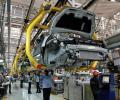
Automobile retail sales in India rose 6 per cent to 2,61,43,943 units in FY25 with rural areas performing better than urban regions across passenger vehicle and two-wheeler segments, dealers' body FADA said on Monday. The last financial year saw growth in sales of passenger vehicles, two-wheelers and three-wheelers.

The services sector growth in India fell to a one-year low in November on softer expansions in new work intakes and output, despite receding price pressures, a monthly survey said on Tuesday. The seasonally adjusted S&P Global India Services Business Activity Index fell from 58.4 in October to a one-year low of 56.9 in November. Despite witnessing a month-on-month decline, the rate of expansion was stronger than its long-run average.

Macrotech Developers (Lodha), the country's second-largest listed real estate company, exceeded its 2024-25 (FY25) guidance, aided by a strong pre-sales performance in the January-March quarter (Q4), driven by launches. The company had guided for Rs 17,500 crore in pre-sales for FY25 and surpassed that with bookings of Rs 17,630 crore.

The US Fed interest rate decision, global trends, tariff-related developments and trading activity of foreign investors will drive the equity market movement this week, analysts said. Among macroeconomic data announcement, WPI inflation for February is scheduled to be announced on Monday.

The S&P BSE Auto Index has been one of the biggest outperformers among sectoral indices over the past year with returns of 26 per cent. By comparison, the benchmarks - the National Stock Exchange Nifty50 and the S&P BSE Sensex - managed about 6-8 per cent during this period. Improving demand, falling raw material costs, and rising product realisations, led by the premiumisation of portfolios, have led to a revision of growth estimates and upgrades by domestic brokerages.

Reserve Bank of India (RBI) Governor Sanjay Malhotra said the repo rate cut in the February meeting of the monetary policy committee (MPC) was due to inflation aligning with the target and recognising the fact that monetary policy is forward-looking.

Fitch Ratings on Friday said it has revised the outlook on India's sovereign rating to 'stable' from 'negative' as downside risks to medium-term growth have diminished on rapid economic recovery. Fitch Ratings kept the rating unchanged at 'BBB-'.

European Union (EU) companies operating in India want New Delhi to streamline or remove non-tariff barriers such as Quality Control Orders (QCOs), complex Customs procedures; simplify labelling, testing, and import procedures; and facilitate cross-border digital transactions without data localisation constraints. These are results of a Business Sentiment Survey, 2025 conducted by the Federation of European Business in India (FEBI) ahead of resumption of negotiations for a free trade agreement (FTA) between both the sides scheduled to be concluded by year-end.

Some major contracts coming up for renewal include TCS' deals with Star Alliance, a consortium of airlines based in Germany, and Nielsen; Infosys' deals with GE Appliances and Daimler; HCLTech's with UK-based life insurer Chesnara; Wipro's with German electric utility company E.ON and Petrobras of Brazil; and Tech Mahindra's with Circle Health.

Both new and completed project values as of December 2024 remain below pre-pandemic levels seen in 2019.
'We believe that in the new world order FTAs or bilateral trade agreements (BTAs) are the way forward.' 'They are enablers for our participation in global value chains. Today, around 70 per cent of global trade is tied to these chains.'

India's largest life insurer, Life Insurance Corporation of India (LIC) reported encouraging performance in the January-March quarter (Q4) of FY24. Total annual premium equivalent (APE) was at Rs 21,180 crore, up 10.7 per cent year-on-year (Y-o-Y), with group APE of Rs 3,890 crore, up 60 per cent Y-o-Y, though individual APE contracted 2.1 per cent Y-o-Y. The participatory book contracted 20.2 per cent Y-o-Y, but the non-par grew by 206 per cent to Rs 3,740 crore.
